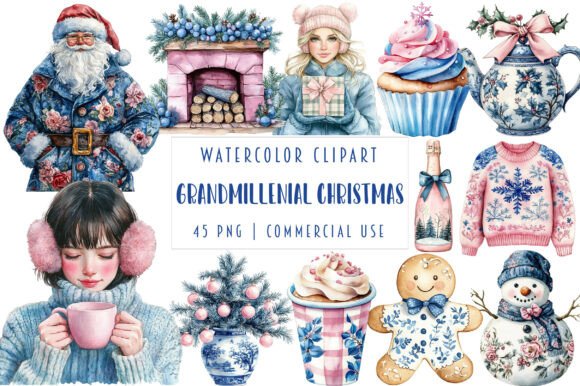
Grandmillenial Christmas Clipart: A Designer’s Review
As an embroidery designer who has spent years digitizing patterns and testing them on everything from delicate silk to heavy canvas, I approach new assets with a critical eye. We are all familiar with the trend cycle, but few styles have stuck around with as much charm as the grandmillennial aesthetic. It is that cozy, slightly nostalgic blend of traditional patterns and modern comfort. When I first pulled up Grandmillenial Christmas Clipart for evaluation, I was not just looking at pretty pictures; I was assessing its viability for real-world stitching. Could these illustrations translate into durable, high-quality machine embroidery designs? Would they hold up on a client’s custom apparel or a boutique product?
First Impressions and Visual Personality
The immediate mood created by this collection is warm and inviting. Unlike stark, minimalist holiday graphics, these pieces carry a sense of heritage. The shapes are organic, often featuring classic motifs like wreaths, vintage ornaments, and botanical elements rendered with a soft, hand-drawn feel. For an embroidery project, this visual personality is a double-edged sword. On one hand, the intricate details suggest a high level of craftsmanship. On the other, they require careful handling during the digitizing process.
When I imagine these assets as part of my design assets library, I see them fitting naturally into projects that prioritize storytelling. They are not just decorations; they are conversation starters. For an Etsy seller or a small shop owner, this distinction matters. Customers are increasingly drawn to items that feel curated and personal. Using Grandmillenial Christmas Clipart as the basis for a digital embroidery file allows you to tap into that desire for authenticity.
Real-World Application: The Custom Tote Bag Test
To truly understand how these illustrations perform, let us look at a specific scenario. Imagine you are preparing a batch of custom embroidered tote bags for a holiday market. You want a design that stands out against natural cotton canvas but does not overwhelm the fabric’s texture. I selected a wreath motif from the clipart set to test this theory.
In a real-life embroidery situation, the success of such a design depends heavily on stitch density and thread choice. If you were to simply auto-digitize these complex lines, you might end up with a stiff, puckered mess. However, when approached with intention, the results are stunning. By converting the finer lines of the clipart into running stitch outlines and using fill stitch for the broader leaf areas, the design retains its artistic integrity while remaining flexible. The finished product feels premium, not mass-produced. This is exactly what buyers look for in a handmade product.
Beyond tote bags, consider sweatshirt embroidery. The soft, slightly blurred edges typical of grandmillennial art translate beautifully into satin stitch borders on fleece or French terry. The contrast between the structured stitch and the cozy fabric creates a tactile appeal that photographs well for printable mockups and social media previews.
Navigating Technical Challenges
While the aesthetic is strong, we must discuss where caution is needed. Not every piece in this collection is suitable for every surface. Small hoop sizes present a significant challenge. If you attempt to shrink a detailed illustration down to fit a 4x4 inch hoop for an embroidered patch or a baby item, you risk losing clarity. Tiny lettering or intricate corners may merge together, especially if the stitch density is too high.
Textured fabrics also demand respect. If you are working with a thick towel or a woven blanket, the fine details of the clipart might get lost in the fabric’s pile. In these cases, I recommend simplifying the design. Remove the smallest elements and focus on the bold shapes. Similarly, when working on stretchy fabric like jersey knits for custom apparel, proper stabilizer use is non-negotiable. Without it, even the best digitized version of Grandmillenial Christmas Clipart can distort after washing.
Dark fabrics pose another hurdle. These illustrations often rely on subtle color variations. On black or navy material, you must ensure high contrast in your thread colors. A dark green thread on a black shirt will vanish. Instead, opt for metallics or bright creams to make the design pop. Always test your design in black and white mockups first to check for value contrast before committing to expensive threads.
Enhancing Brand Value and Customer Trust
Why go through this trouble? Because the right design elevates your brand. When a customer receives a personalized gift featuring a well-executed holiday embroidery, they perceive higher value. It signals professionalism and attention to detail. For craft business owners, consistency is key. Using a cohesive set of illustrations like this helps build brand recognition. Whether it is a kitchen towel, a cap, or nursery decor, the consistent visual language tells your audience who you are.
Moreover, these designs are highly giftable. Holiday embroidery sells because it carries emotional weight. A pillow cover with a vintage-inspired motif feels like an heirloom. This emotional connection drives buyer engagement and repeat business. As a digital product seller, offering these as pre-digitized options can save your clients time while ensuring they achieve a professional look.
Practical Notes for the Embroidery Designer
Before you launch into production, here are my essential recommendations for working with this type of artwork:
- Test on scrap fabric first: Never stitch directly on your final garment. Check for puckering and thread breaks.
- Check thread color contrast: Ensure your palette complements the fabric background. Use a color chart physically, not just on screen.
- Review stitch density: High density looks lush but can cause stiffness. Balance fill stitch with open areas.
- Confirm hoop size: Make sure the design fits your machine’s maximum area without resizing below readable limits.
- Inspect small details: Zoom in on your digitizing software. Are there stray stitches? Are jumps minimized?
- Use proper stabilizer: Match the stabilizer to the fabric weight. Cut-away for knits, tear-away for wovens.
- Verify licensing: Before selling finished items or digital embroidery files, confirm that the clipart license allows for commercial embroidery use. Terms vary by creator.
Ultimately, Grandmillenial Christmas Clipart offers a rich foundation for creative entrepreneurs. It bridges the gap between digital art and tangible craft. Whether you are creating a single personalized gift or stocking your small shop product line for the season, these illustrations provide the charm and character that modern buyers crave. Just remember that the magic lies not just in the image, but in how you translate it into thread and fabric. Take your time, respect the materials, and let the design shine through your craftsmanship.